



On June 27, 2026, the Government issued Decree No. 245/2026/NĐ-CP (“Decree 245/2026”) on the extension of deadlines for payment of value-added tax (VAT), corporate income tax (CIT), personal income tax (PIT), and land rental fees in 2026. The Decree takes effect from the date of signing, i.e., from June 27, 2026, and remains in force until December 30, 2026. This is a long-awaited decree by the business community and is expected to have a positive impact on business and production activities.
1. Eligible subjects for the extension of VAT, CIT, PIT, and land rental payments in 2026
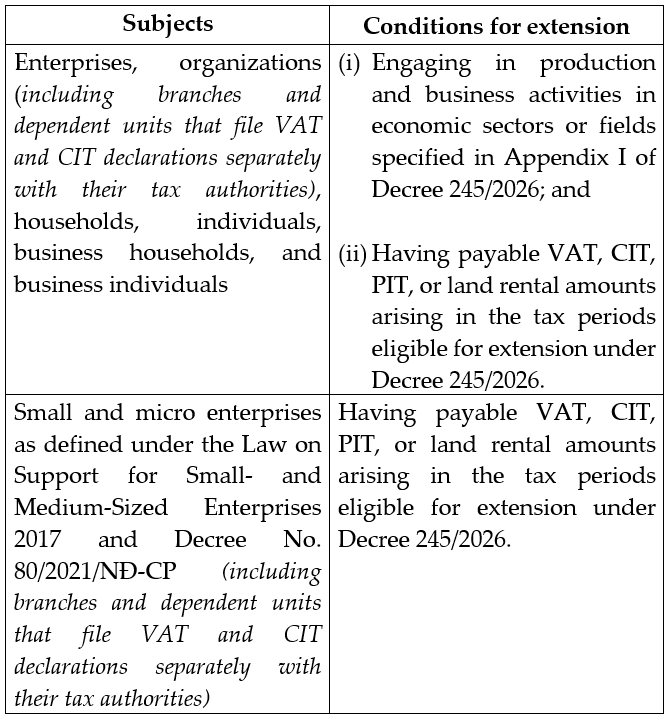
Thus, Decree 245/2026 provides that only enterprises, organizations, households, individuals, business households, and business individuals operating in 43 sectors and fields specified in Appendix I of Decree 245/2026 are eligible for the extension of VAT, CIT, PIT, and land rental payments in 2026. Small and micro enterprises are eligible regardless of their business lines or sectors.
2. Extension of tax payment deadlines
2.1 CIT
For quarterly provisional CIT payments, the extension period is as follows:[1]
- Quarter II/2026: extended by 03 months, with the latest payment deadline being November 2, 2026.
- Quarter III/2026: extended by 02 months, with the latest payment deadline being December 30, 2026.
2.2 For VAT (excluding import VAT)
The extension period for VAT payable (including allocated VAT and VAT payable on a per-occurrence basis) is up to 05 months. Specific deadlines are as follows:[2]
| Tax period | Latest payment deadline |
| May 2026 | November 20, 2026 |
| June, July, August, September 2026 | December 21, 2026 |
| Quarter II/2026 | November 2, 2026 |
| Quarter III/2026 | December 30, 2026 |
2.3 For PIT
The extension period for PIT payable by business households and business individuals is up to 05 months and follows the same deadlines as VAT specified in Section 2.2 above.[3]
Notes:
- Where enterprises, organizations, business households, or business individuals engage in multiple business lines, if at least one line falls under Appendix I of Decree 245/2026, the extension applies to the entire payable amount of CIT, VAT, and PIT.[4]
- Where taxpayers submit supplementary tax declarations for eligible tax periods resulting in an increase in payable tax, such supplementary declarations must be submitted before the extended deadline. If submitted after the extended deadline, the increased payable amount will not be eligible for extension.[5]
During the valid extension period, enterprises will not be subject to late payment interest on the deferred tax and land rental amounts. This effectively allows enterprises to access an “interest-free” working capital source from the State.
3. Extension of land rental payment deadlines
An extension is granted for 50% of the land rental amount payable in 2026 (i.e., the first installment of 2026) for land users who are directly leased land from the State under decisions of or contracts signed with competent authorities, with annual rental payment arrangements. The extension period is 05 months, and the latest extended payment deadline is November 2, 2026.[6]
4. Requirement to submit an application for extension
The extension is not automatic. Taxpayers must submit an Application for Extension of Tax and Land Rental Payments to their directly managing tax authorities once, together with the submission of monthly (or quarterly) tax declarations. The application may be submitted electronically, in hard copy directly to the tax authority, or via postal services. If not submitted together with the tax declaration, the latest submission deadline is November 2, 2026. If submitted after this date, the taxpayer will not be eligible for the extension.[7]
Decree 245/2026 provides practical benefits to enterprises by improving short-term cash flow, reducing financial pressure, and supporting the continuity of business operations, while not reducing tax obligations.
This policy is particularly meaningful for exporting enterprises, manufacturing enterprises, industrial real estate companies, logistics companies, and small and micro enterprises. Retaining funds for 2–5 months enables enterprises to pay wages, purchase raw materials, fulfill contracts, and maintain operations. This is the key objective of Decree 245/2026 in stimulating economic growth in 2026.
Enterprises should proactively review eligibility conditions, comply with application procedures, and develop appropriate financial plans to ensure sufficient funds are available when tax obligations become due after the extension period.
[1] Article 2.2 of Decree 245/2026
[2] Article 2.1 of Decree 245/2026
[3] Article 2.1 of Decree 245/2026
[4] Article 2.5 of Decree 245/2026
[5] Article 2.4 of Decree 245/2026
[6] Article 2.3 of Decree 245/2026
[7] Articles 3.2 and 3.3 of Decree 245/2026