

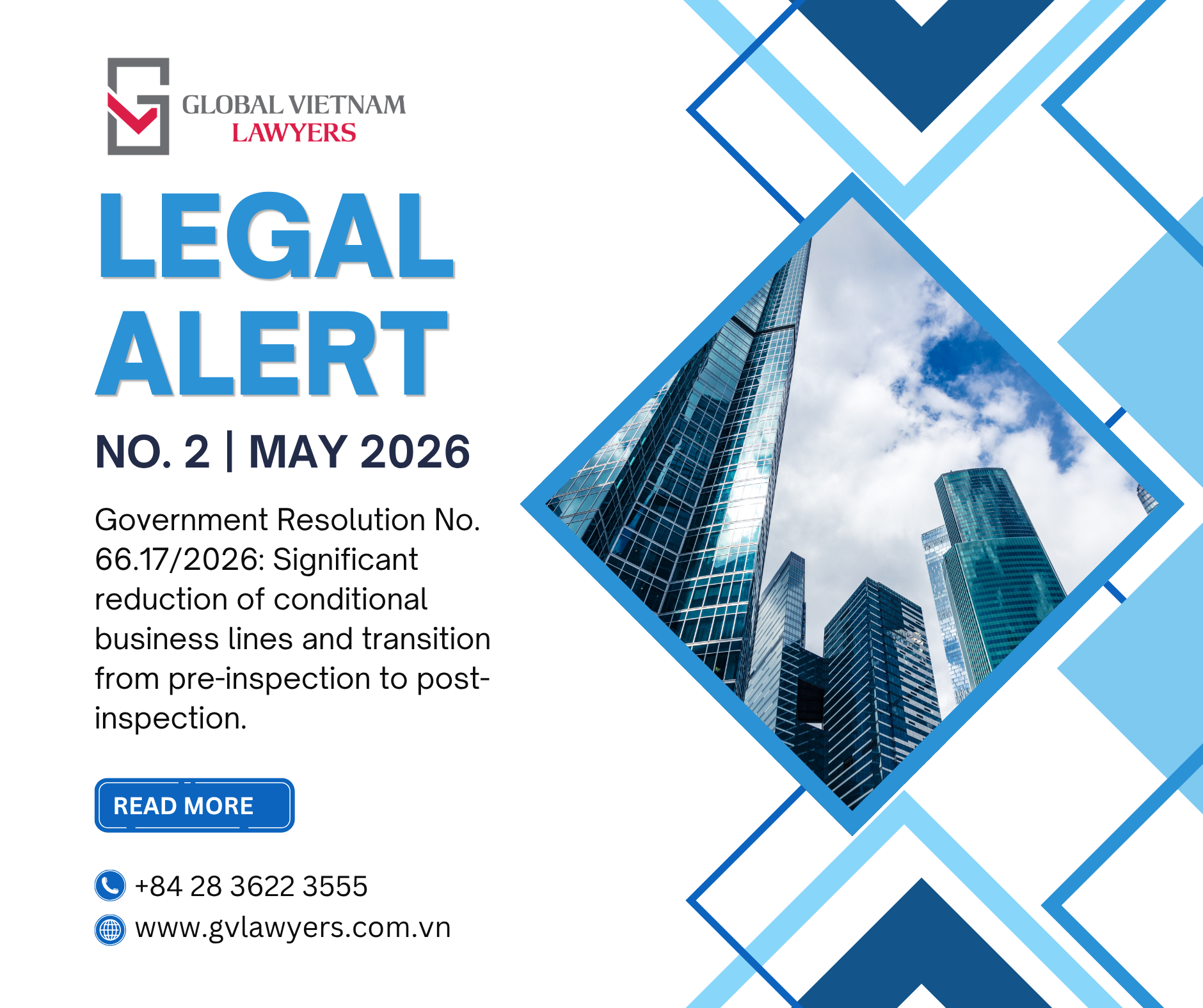
On May 15, 2026, the Government issued Resolution No. 66.17/2026/NQ-CP (“Resolution 66.17/2026”) on the reduction and amendment of conditional business lines as stipulated in Appendix IV of the 2025 Law on Investment. Resolution 66.17/2026 shall take effect from July 1, 2026 to February 28, 2027, with several key provisions that investors and enterprises should pay attention to as follows:
1. Reduction of 56 conditional business lines
Resolution 66.17/2026 reduces the number of conditional business lines from 198 to 142, thereby eliminating 56 business lines from the existing list of conditional business lines.
The removed business lines include, among others: accounting services; foreign exchange services provided by non-credit institutions; unmanned aerial vehicle (drone) business; occupational safety and hygiene training services; publication distribution services; mineral trading; rice export; construction inspection services; maritime transport business; betting business; casino operations; insurance agency services; insurance brokerage services; etc.
Accordingly, from July 1, 2026, these sectors will no longer fall under the List of conditional business lines as defined in Appendix IV of the Law on Investment. As a result, investors and enterprises will no longer be required to meet market entry conditions under the “conditional business sector” regime as previously applied. However, depending on specific industries, enterprises may still be required to comply with relevant sector-specific regulations, including operating licenses, technical standards, professional requirements, safety regulations, practicing certificates, or other forms of state management in accordance with applicable laws.
2. Transition from “pre-inspection” to “post-inspection”
For certain business lines removed from the List of conditional business lines, state authorities are shifting from a pre-inspection mechanism (requiring licenses or approvals prior to operation) to a post-inspection mechanism. Under this approach, state management will be carried out through technical standards and norms, professional standards, and other sector-specific requirements.
Relevant ministries will coordinate with the Ministry of Science and Technology to develop, amend, or issue technical regulations and corresponding management mechanisms using streamlined procedures or processes, ensuring alignment with the effective date of Resolution 66.17/2026 form July 1, 2026.
3. Validity of Existing Licenses
Resolution 66.17/2026 allows organizations and individuals that have already been granted licenses (including permits, certificates, professional licenses, confirmations, or other forms of approval for investment and business activities) within business lines subject to reduction to continue using such licenses until their expiration dates.
The significant reduction in the number of conditional business lines is considered a major reform in improving Vietnam’s investment and business environment. It aims to remove administrative barriers and promote a shift from “pre-inspection” to “post-inspection” regulatory model. This reform enables enterprises to enter the market more quickly and conveniently, while reducing time, costs, and administrative procedures in the preparation of investment and business activities. However, enterprises must proactively comply with sector-specific regulations, technical standards, and state management requirements during their operations under the post-inspection mechanism.