
Global Vietnam Lawyers would like to introduce our valued readers to an article by Lawyer Le Quang Vy titled “AI and copyright – A perspective from Vietnamese law” published in The Saigon Times, 18-2026 (1.846) on April 30, 2026.
***
The rapid growth of artificial intelligence (AI) has been fundamentally reshaping how content is created across various fields such as science, music, film, publishing, design, and digital media. In this context, the determination of intellectual property (IP) rights in AI-generated products has become an urgent legal issue.
Vietnam has made notable progress in this area. At its 10th session on December 10, 2025, the 15th National Assembly passed a law amending the IP Law, including a provision addressing cases where IP subject matter is created with the use of AI. Subsequently, on March 31, 2026, the Government issued Decree No. 100/2026/ND-CP to detail the establishment of rights in industrial property created with the use of AI. Shortly thereafter, on April 6, 2026, the Government promulgated Decree No. 134/2026/ND-CP, amending and supplementing Decree No. 17/2023/ND-CP, concerning the emergence of copyright and related rights in literary and artistic works, performances, recordings, and broadcasts involving AI.
Humans remain at the center of creative works
Article 6 of the IP Law expressly regulates the emergence and establishment of IP rights in cases where the protected subject matter is created with the use of AI. Accordingly, both Decree 100/2026 and Decree 134/2026 affirm that AI cannot be recognized as a rights holder in relation to industrial property, copyright, or related rights. Subject matter within the scope of industrial property, copyright, and related rights that is generated with the assistance of AI will only give rise to legal protection where there is a significant and determinative human contribution in the creative process. This reflects a consistent viewpoint: AI is merely a tool, while the creative element—the foundation of copyright—must originate from human intellect.
Decree 100/2026 clearly provides that, with respect to industrial property rights such as inventions, industrial designs, and layout designs created through the use of AI, protection is granted only where humans have made a significant contribution to their creation. Similarly, Decree 134/2026 stipulates that literary and artistic works, performances, recordings, and broadcasts created with the use of AI will give rise to copyright and related rights only where humans have made a significant and determinative contribution to the creation of the work, or to the fixation or performance of such works.
This marks a notable development in Vietnam’s IP Law in addressing this issue, aligning with international trends, as many jurisdictions and organizations—such as the United States and the European Union—decline to recognize copyright in works generated entirely by AI. At the same time, the regulations leave room for protection of AI-assisted outputs, provided that the human creator can demonstrate their control and intellectual contribution.
What constitutes a “significant contribution”?
Decree 100 and Decree 134 further elaborate the notion of “significant contribution” through activities such as: formulating prompts, selecting and processing input data, editing outputs, making creative decisions, and assuming responsibility for the final product. This represents an important step forward in distinguishing genuine creators from those who merely use AI in a passive manner.
With respect to industrial property rights, where AI is involved, a human will only be recognized as an author or inventor if they have made a significant contribution to the creation of the invention, industrial design, or layout design. Specifically, the human must carry out all activities including: (i) identifying the problem to be solved, encompassing both the idea and the solution rather than a general description; (ii) selecting input data derived from human creative ideas, rather than relying solely on pre-existing data or AI-generated suggestions; (iii) evaluating, selecting, editing, testing, and interpreting AI-generated outputs but the edits must alter the core structure or function of the outputs so as to create new value; and (iv) making the final decision on the outputs.
Notably, Article 10a.3 of Decree 100 provides that, for industrial property subject matter created by AI without significant human contribution, although the law does not grant IP protection, the user of AI may still use and authorize others to use such subject matter, provided that this does not infringe upon the lawful rights and interests of other organizations or individuals.
For creators of literary and artistic works involving AI, point (a), clause 1, Article 5a of Decree 134 stipulates that humans must make a significant and determinative contribution to the creation of the work. Specifically: (i) humans must provide original input data and technical parameters, formulate prompts, and evaluate, edit, intervene in, or interpret AI-generated outputs; humans must also select, arrange, and organize the content and form of expression of the work, performance, recording, or broadcast in order to make decisions on artistic, aesthetic, and professional matters, thereby producing a final output that reflects their own ideas rather than a random or automated arrangement by algorithms; (ii) humans must assume responsibility for the copyrighted work created with the use of AI; and (iii) the use of AI must not prejudice the copyright or related rights in materials used as input data. Accordingly, where these criteria are not met, outputs generated entirely by AI will not give rise to copyright or related rights. It should be noted that performers’ related rights arise only for individuals who directly perform artistic acts.
Vietnamese law expressly provides that outputs generated by AI, without significant human contribution, do not qualify for copyright protection. This approach helps safeguard genuine creators and prevent an inflation of copyright claims. The IP Law permits organizations and individuals to use data relating to IP subject matter that has been lawfully published for the purpose of training AI. However, such use must not unreasonably prejudice the rights and interests of authors and copyright holders. At the same time, the law allows authors, performers, and owners of copyright and related rights to reserve their rights—that is, to opt out of allowing their protected works or IP subject matter to be used as training data for AI. However, this reservation right does not apply where the data has been lawfully published and is lawfully accessible to users. Notably, the law expressly states that: “AI-generated outputs must not undermine the normal market for copyrighted works or protected subject matter under related rights, nor create unfair competition in relation to their exploitation and use.”
That said, the law does not yet clarify the mechanism for determining liability in cases of infringement. Should liability rest with the user of AI, or with the provider of the AI system? This gap may give rise to complex disputes in the future, particularly in fields such as music and visual arts. In addition, to avoid inconsistent application, potential disputes, challenges for courts, or cases where authorship is granted despite minimal contribution etc. the law should provide more quantitative criteria—such as how much modification constitutes a “significant” contribution, and the relative value of different forms of contribution, such as prompt-writing skills, and aesthetic, artistic, or professional decisions.
Obligation of providing proof and making truthful disclosure
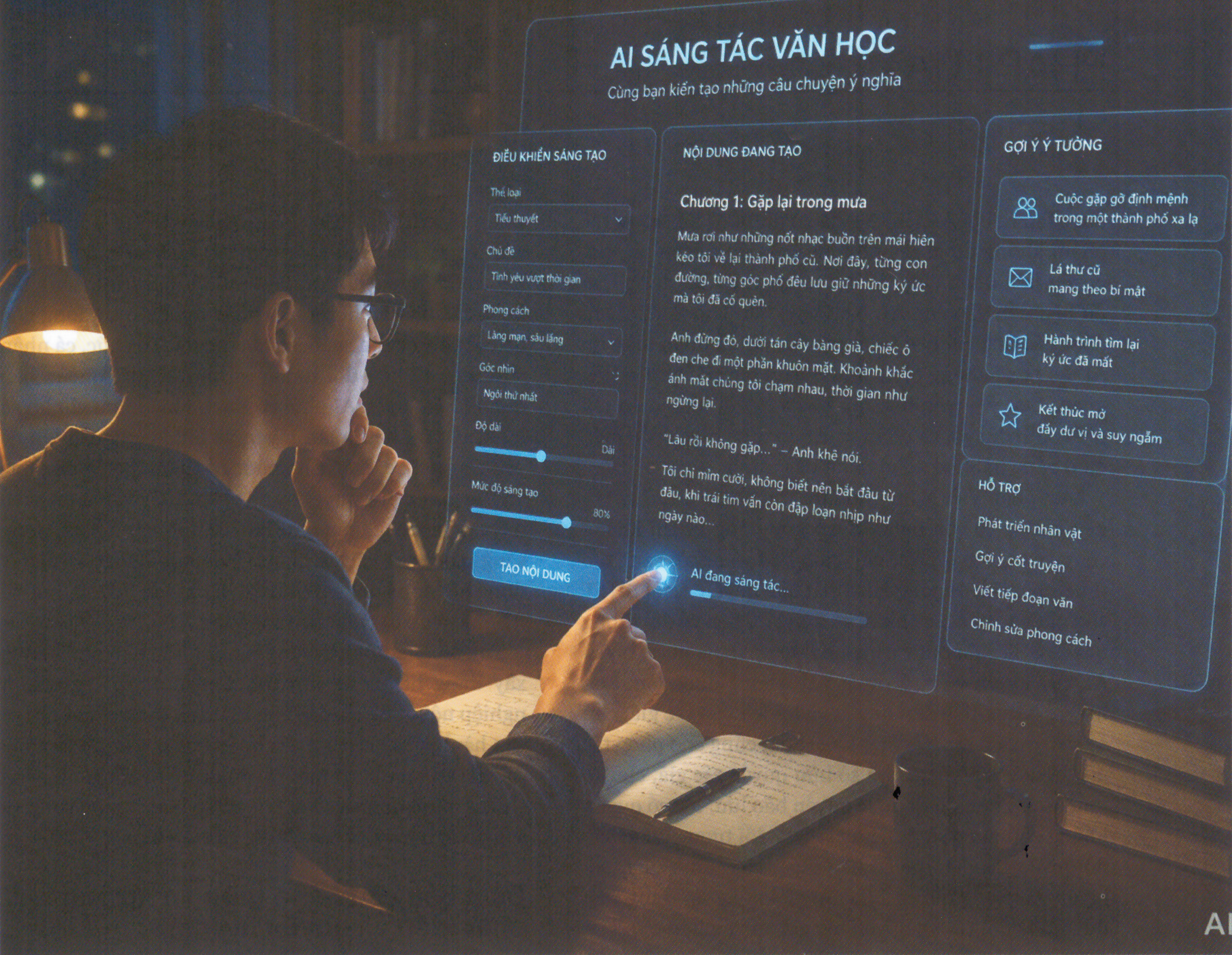
Decree 134 provides that, in the event of a dispute or upon request by a competent authority, one seeking protection of rights must provide documents proving the workflow involving AI in the creation of literary and artistic works, and truthfully disclose the use of AI. Such proof may include: (i) input data, technical parameters, drafts, intermediate versions, and revisions during the creative process; (ii) prompt history and interaction logs; and (iii) documents describing the creative process or other lawful materials showing human intellectual contribution and control. Entities and individuals using copyrighted or related-rights-protected data to train AI are responsible for keeping technical records and training datasets, and must provide such materials upon request by competent state authorities for purposes of verification, dispute resolution, or enforcement. This establishes a new standard of transparency in creative activities, requiring individuals and businesses to develop storage systems (for prompts, histories, documentation, etc.) to manage creative data.
However, in practice, individuals rarely establish such storage systems. For businesses producing digital content, this poses both a challenge in terms of cost and operations, and an opportunity to standardize workflows and enhance the value of intellectual assets. Accordingly, to reduce the burden of proof associated with data storage, the draft should introduce mechanisms such as reasonable inference and the acceptance of indirect evidence.
Balancing development trends and copyright protection
Vietnamese law currently provides that works generated entirely by AI are not eligible for copyright protection. However, in light of ongoing technological development, it is worth reconsidering this approach in order to safeguard the economic value generated by AI-created outputs in the future. As AI becomes increasingly capable of producing high-quality content, the absence of protection mechanisms may weaken the motivation for investment and technological development, while also creating legal gaps in commercial exploitation.
Overall, Vietnam’s amendments to its IP Law reflect an effort to balance two objectives: encouraging AI-driven innovation and safeguarding the legal foundations of copyright protection. This is a necessary step in the context of the rapid digital transformation of the cultural and creative industries. However, for these regulations to be effectively implemented, further detailed guidance is needed—particularly the criteria for assessing creative contribution and mechanisms for handling input data. At the same time, businesses and creators must proactively adapt by establishing structured and well-controlled workflows with the involvement of AI.
In the AI era, copyright is no longer merely a matter of individual creativity; it has evolved into a complex ecosystem where technology and law must go hand in hand to shape the future of the creative industry.