



Law on Management and Investment of State Capital in Enterprises No. 68/2025/QH15 (“Law 2025”) was passed by the National Assembly on June 14, 2025 to replace Law on Management and Use of State Capital to Invest in Production and Business at Enterprises No. 69/2014/QH13. The new law will officially take effect from August 1, 2025, marking an important shift in the way state-owned enterprises are managed when representatives of state capital are given more autonomy in reporting, explaining, and requesting approval compared to previous regulations.
1. State capital owners do not directly intervene in the production and business activities of enterprises
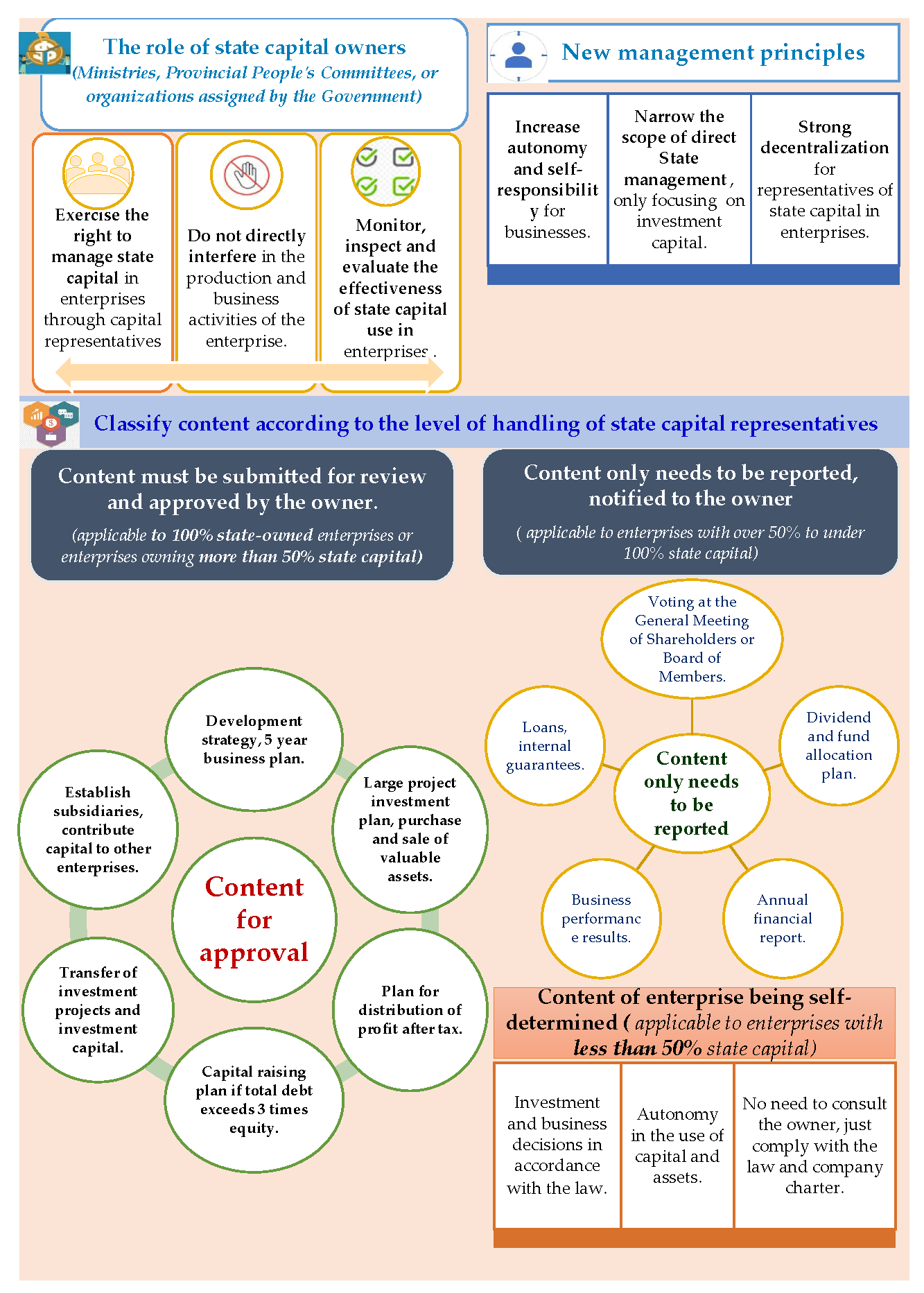
Regarding the principles of state capital management and investment in enterprises, the Law 2025 emphasizes that the state capital owner or the owner’s representative agency (“ORA”) does not directly intervene in the production and business activities of the enterprise. Instead, the ORA is in charge of supervising, inspecting, and evaluating the effectiveness of the use of state capital in the enterprise. The management of state capital in the enterprise must be conducted through a representative, the Direct Owner Representative (which is the Board of Members (“BOM”), Chairman of the Company (“COC“) for enterprises with 100% state capital) or the Representative of State Capital (“RSC”) (for enterprises with less than 100% state capital ).[1]
2. Details about implementation of autonomy and accountability by state capital representatives
The Law 2025 clearly stipulates the contents that the representative must report and request approval from the owner (“Approval content”) or only need to report and notify the owner (“Report content”) or can decide by himself (“Self-determination content”) as follows:
- Development strategy, 5-year and annual business plans
Report content: The BOM and the COC decide on the issuance and adjustment of the development strategy and annual business plan of the enterprise in accordance with the basic targets assigned by the representative of the state owner, as well as approving the annual financial report of the enterprise. [2]
Approval content: Development strategy, 5 years business plan beyond the targets assigned by the state capital owner.
- Decision on investment projects, purchase and sale of fixed assets
Report content: The BOM and the COC decide to invest or purchase and sell fixed assets of the enterprise for investment projects, investments, and fixed assets with a value not exceeding 50% of the owner’s equity or not exceeding 50% of the owner’s investment capital[3].
Approval content: For investment projects, investments, or purchased or sold fixed assets with value greater than the prescribed level of 50%, the BOM or the COC must report to the Investment Registration Office for approval before deciding to invest.[4]
- Distribution of after-tax profits, dividends and fund allocation
Approval content: The distribution of after-tax profits of the enterprise must be reported for approval from the ORA.[5]
Report content: Before giving opinions, voting, and making decisions at the General Meeting of Shareholders, meetings of the BOM and the Board of Directors to distribute dividends and distribute after-tax profits to set up funds, the RSC must report to the ORA.
- Capital mobilization plan
Report content: Enterprises are allowed to decide on capital mobilization plans according to the principle of self-borrowing, self-repaying and are responsible for their decisions[6].
Approval content: In case capital mobilization leads to total debt payable (including guarantees) exceeding 3 times the enterprise’s equity, the enterprise must report to the ORA after approving the capital mobilization plan for supervision according to regulations.[7]
- Transfer of investment projects and investment capital
Report content: The BOM or the COC decides to transfer an investment project, the investment capital with a value of not more than 50% of the owner’s equity or not more than 50% of the owner’s investment capital. (Previously, all transfers must be approved by the ORA)
Approval content: In case the transfer value is greater than 50% of the prescribed level, the BOM or the COC must report to the ORA for approval before deciding to transfer.[8]
- Loans, internal guarantees
Report content: Enterprises are allowed to decide to lend/guarantee based on the following principles: (i) only lend/guarantee to companies in which the enterprise holds more than 50% of the charter capital; and (ii) the total value of guarantees or the total value of loans for each company does not exceed the actual capital contribution value of the enterprise at the time of guarantee/loan.[9]
Approval content: Loans/guarantees exceeding the actual capital contribution of the enterprise must be reported to the ORA for consideration and approval [10].
- Business performance report
The RSC reports to the representative of the state owner the following contents: development strategy, annual business plan of the enterprise; Resolutions and decisions of the BM, General Meeting of Shareholders, Board of Management; quarterly plan implementation results (including investment projects, progress of implementation of investment projects of the enterprise); financial situation of the enterprise.[11]
- Autonomy of enterprises with less than 50% state capital
The RSC in an enterprise in which the State holds 50% or less of the charter capital is entitled to decide on the investment and business activities of the enterprise on the basis of compliance with the the law on enterprises, the company charter and the operating regulations of the RSC.[12]
From the above presentation, we can understand the role of state owners and the right to self-determination and self-responsibility of state capital representatives as follows:
[1]Article 5 of the Law 2025
[2]Article 18, 36.2 of the Law 2025
[3]Article 20.3(a), 22.1 of the Law 2025
[4]Article 20.3(b), 22.1 of the Law 2025
[5]Article 25.1 of the Law 2025
[6]Articles 19.1 and 19.4 of the Law 2025
[7]Article 19.5 of the Law 2025
[8]Article 21.2 of the Law 2025
[9]Articles 19.2, 19.3, 23.1(c) of the Law 2025
[10]Article 19.3 of the Law 2025
[11]Articles 39.5, 40.3, 54.1 of the Law 2025
[12]Article 28 of the Law 2025