


Decree 226/2025/ND-CP (“Decree 226/2025”), effective from August 15, 2025, has brought about significant changes in the detailed regulations implementing the Land Law. Most notably, the official abolition of the land price bracket moves toward the application of a uniform land price list nationwide.
This Decree is expected to create a more transparent legal framework, reflecting the market value of land use rights, contributing to harmonizing the interests of the State, people and enterprises.
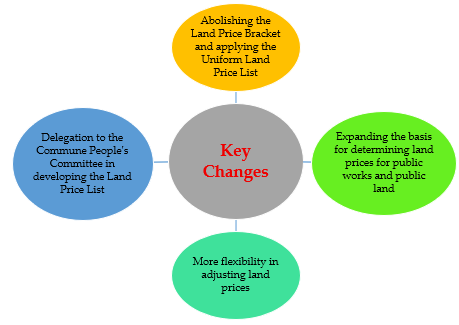
Key Changes and Impact
1. Abolishing the Land Price Bracket and applying the Uniform Land Price List
- Core changes: Previously, the Law on Land 2013 stipulated that the land price bracket is the price regulated by the Government, issued periodically every 5 years as a basis for the People’s Committees of provinces and cities to build, announce and apply the land price list in each locality. The Law on Land 2024 (effective from August 1, 2024) has abolished the regulations on land price bracket and instead applied the annual land price list by area and location developed by the Provincial People’s Committee, submitted to the People’s Council for decision on the first land price list applied from January 1, 2026, then adjusted and applied from January 1 of the following year, and up to now (August 15, 2025), the regulations on the new land price bracket have been officially abolished pursuant to Article 9 of Decree 226/2025 abolishing Decree No. 96/2019/ND-CP of the Government regulating the land price bracket. From August 15, 2025, the regulations on the land price bracket have been officially abolished.
- New regulation: Instead of the land price bracket issued by the Government every 5 years, the 2024 Land Law (effective from August 1, 2024) stipulates the application of an annual land price list developed by the Provincial People’s Committee and submitted to the People’s Council for decision. This land price list will be developed based on market data, ensuring that it closely follows actual fluctuations.
2. Expanding the basis for determining land prices for public works and public land
- Previous regulation: Previously, when the land price list did not include land prices for the same purpose of use, determining land prices for public and non-business public works had to be based on residential land prices in the surrounding area.
- Changes in Decree 226/2025: Now, in addition to being based on residential land prices, these types of land can also be priced based on commercial and service land prices in the surrounding area. Particularly for public works land, it can be based on commercial and service land prices or non-agricultural production land prices in the surrounding area.
3. More flexibility in adjusting land prices
- New regulation: Previously, Article 20.2 of Decree 71/2024/ND-CP only stipulated that the Provincial People’s Council is allowed to determine higher (increased) land prices for commercial and service land, non-agricultural production and business land that is not commercial and service land with high profitability, with advantages in using land as production, business, trade and service premises; agricultural land in residential area to determine land location in the formulation of land price list. However, according to Article 1.11 of Decree 226/2025, the Provincial People’s Council can increase or decrease land prices for land groups with high profitability (such as land for purposes of commerce, services, non-agricultural production) depending on the reality.
- Important addition: Decree 226/2025 also adds ” agricultural land in the same plot of land with housing” to the group of plots of land with favorable or unfavorable factors for price adjustment.
4. Delegation to the Commune People’s Committee in developing the Land Price List
- Previous regulation: Previously, this task was performed by the District People’s Committee.
- Changes in Decree 226/2025: According to the decentralization policy, the People’s Committee at the commune level will develop land price lists and decide on specific land prices under the direction of the People’s Committee at the provincial level.
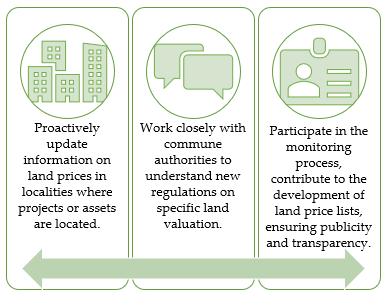 Thus, the abolition of the land price bracket and the application of a uniform land price list nationwide, built on practical data and regularly updated, is expected to create a more transparent legal foundation, accurately reflecting the value of land use rights, contributing to the transparency of the real estate market, ensuring the harmony of interests among the State, people and enterprises. To effectively take advantage of the new policy, enterprises and investors need to: